May 5, 2026 • Declan Harte • 10 min reading time • Specs verified June 5, 2026
weBoost Home Complete vs. Hiboost 10K vs. Cel-Fi GO X: Whole-Home Booster Showdown
If you’ve ever walked from your living room into your kitchen and watched one bar disappear, you already understand the problem this article is solving. A cell signal booster pulls in weak signal from outside your home using an outdoor antenna, amplifies it, and rebroadcasts it indoors — so your phone behaves like it’s standing on the sidewalk outside rather than buried in drywall and interference. The outdoor antenna talks to the nearest cell tower; the indoor antenna talks to your phone; the amplifier in the middle does the heavy lifting. When the setup is right, the improvement is dramatic. When the setup is wrong, you have $400 of coax and frustration in your attic. This guide compares three of the most-discussed premium whole-home options for 2026 — the weBoost Installed Home Complete, the Hiboost 10K Smart Link, and the Nextivity Cel-Fi GO X — and gives you an honest decision framework for choosing the right one, or knowing when none of them is the answer.
| EDITOR'S PICKCEL-FI GO G41 Cell Phone Booste… | Mid-tierweBoost Home Complete Cell Phon… | Budget pickweBoost Home Complete | Powerfu… | |
|---|---|---|---|
| Max Coverage | 15,000 sq ft | — | — |
| Gain | 100 dB | — | — |
| Carrier Support | AT&T, Verizon, T-Mobile | All U.S. Carriers | All U.S. Carriers |
| Indoor Antenna Qty | 1 | — | — |
| Price | $1,699.99 | $1,499.99 | $999.99 |
| See on Amazon → | See on Amazon → | See on Amazon → |
Why “Premium” Matters Here (and What You’re Actually Comparing)
Before the numbers: there is no such thing as a booster that works with zero outside signal. If you have zero bars outdoors, no amplifier will help you. What these devices do is take marginal, weak signal — the kind that clocks in around –100 to –115 dBm (decibel-milliwatts, the standard unit for signal strength; more negative equals weaker) — and amplify it enough to cover your interior.
The FCC, under its Part 20 consumer signal booster rules, caps the maximum uplink power these devices can transmit so they do not interfere with tower networks. That regulatory ceiling shapes everything about how these products compare. As the FCC’s consumer guidance document “Consumer Signal Boosters” explains in plain text on fcc.gov, all boosters sold in the United States must be certified under Part 20, and operators must register smart repeaters with their carrier before use. The same document clarifies that smart repeaters — such as the Cel-Fi GO X — operate under a separate classification from traditional bi-directional amplifiers, which is why carrier-locking is a condition of their legal operation.
At the premium end of the residential market, you are choosing between two fundamental design philosophies:
- Traditional bi-directional amplifier (BDA): boosts all carriers simultaneously, offers configurable gain, and works with any antenna configuration. The weBoost Home Complete and Hiboost 10K Smart Link fall here.
- Smart repeater / carrier-specific amplifier: locks onto one carrier, applies interference-rejection logic, and extracts more gain from a weaker signal than any BDA legally can. The Cel-Fi GO X is the defining example of this category.
That distinction is the whole ballgame. Let’s go product by product.
The Three Contenders: Specs at a Glance
| Spec | weBoost Home Complete | Hiboost 10K Smart Link | Cel-Fi GO X |
|---|---|---|---|
| Max gain (dB) | 72 | 72 | 100 |
| Carrier coverage | All carriers | All carriers | Single carrier |
| Low-band 5G (n71/n5) | Yes | Yes | Yes (carrier-specific) |
| Mid-band 5G (n41) | No | No | No |
| FCC Part 20 certified | Yes | Yes | Yes (network extender classification) |
| Approx. DIY price | ~$550 | ~$400 | ~$700 |
| Professional install available | Yes (bundled option) | Third-party only | No |
Head-to-Head: Each Booster in Detail
weBoost Installed Home Complete
The weBoost Home Complete hardware package — sold as a DIY kit at roughly $550–$600 — includes a high-gain directional outdoor antenna, a 72 dB gain amplifier, and an indoor panel antenna. The “Installed” version pairs that hardware with a professional installation appointment through a national installer network, bringing the all-in price to approximately $1,000.
PCMag, in its regularly updated roundup “The Best Cell Phone Signal Boosters,” consistently ranks weBoost hardware near the top of the residential category for maximum-gain scenarios. The publication specifically cites the professional installation option as a meaningful differentiator for homeowners who do not want to manage antenna aiming themselves — a point we return to in the installation section below.
The directional outdoor Yagi antenna focuses signal on one tower direction rather than receiving omnidirectionally. Combined with the 72 dB amplifier, this kit has the headroom to pull usable signal from towers 10–15 miles away in flat terrain. Manufacturer specifications rate coverage at up to 7,500 square feet under ideal outdoor signal conditions, though real-world whole-home coverage at that number requires strong incoming signal and precise antenna placement.
The core tradeoff: This is a carrier-agnostic BDA. It amplifies every carrier in the band simultaneously, which means gain is distributed across all active signals in the space. In a household where one carrier dominates, this is ideal. In a scenario where the Cel-Fi GO X’s single-carrier focus would extract more from a genuinely marginal signal, the weBoost will trail — but only when every device in the home is on the same carrier.
Who it’s for: Mixed-carrier households, anyone who values professional installation, and owners of larger homes where broad indoor coverage across multiple carriers is the priority.
CEL-FI
$1,699.99
In stock on Amazon
Check price on AmazonHiboost 10K Smart Link
The Hiboost 10K is a 72 dB maximum-gain amplifier that competes directly with the weBoost Home Complete on specification — same gain ceiling, similar band coverage across Bands 2, 4, 5, 12, 13, 17, 25, 26, 66, and low-band 5G n71 on current firmware. The “Smart Link” designation refers to Hiboost’s companion app, which monitors signal levels and lets you adjust indoor antenna output zone by zone if you are running a multi-antenna cable split.
CNET, in its buying guide “Best Cell Signal Boosters,” notes that app-based monitoring appeals to technically comfortable homeowners who want to iterate on placement over time rather than configure and forget. The Hiboost’s real differentiator is price: at roughly $400 for the DIY kit, it undercuts the weBoost hardware by $150–$200 while matching it on the specification that matters most — maximum gain.
The core tradeoff: Hiboost’s installer and retailer support ecosystem is thinner than weBoost’s. Pre-sale consultation depth for Hiboost-specific deployments is less developed at major authorized resellers. If you are going DIY in a complex building — multiple floors, concrete interior walls, a finished basement — you are more on your own with troubleshooting and antenna optimization.
Who it’s for: Budget-conscious buyers with at least moderate DIY confidence, mixed-carrier households, and homeowners who want granular app-based diagnostics without paying for professional installation.
weBoost
$1,499.99
In stock on Amazon
Check price on AmazonNextivity Cel-Fi GO X
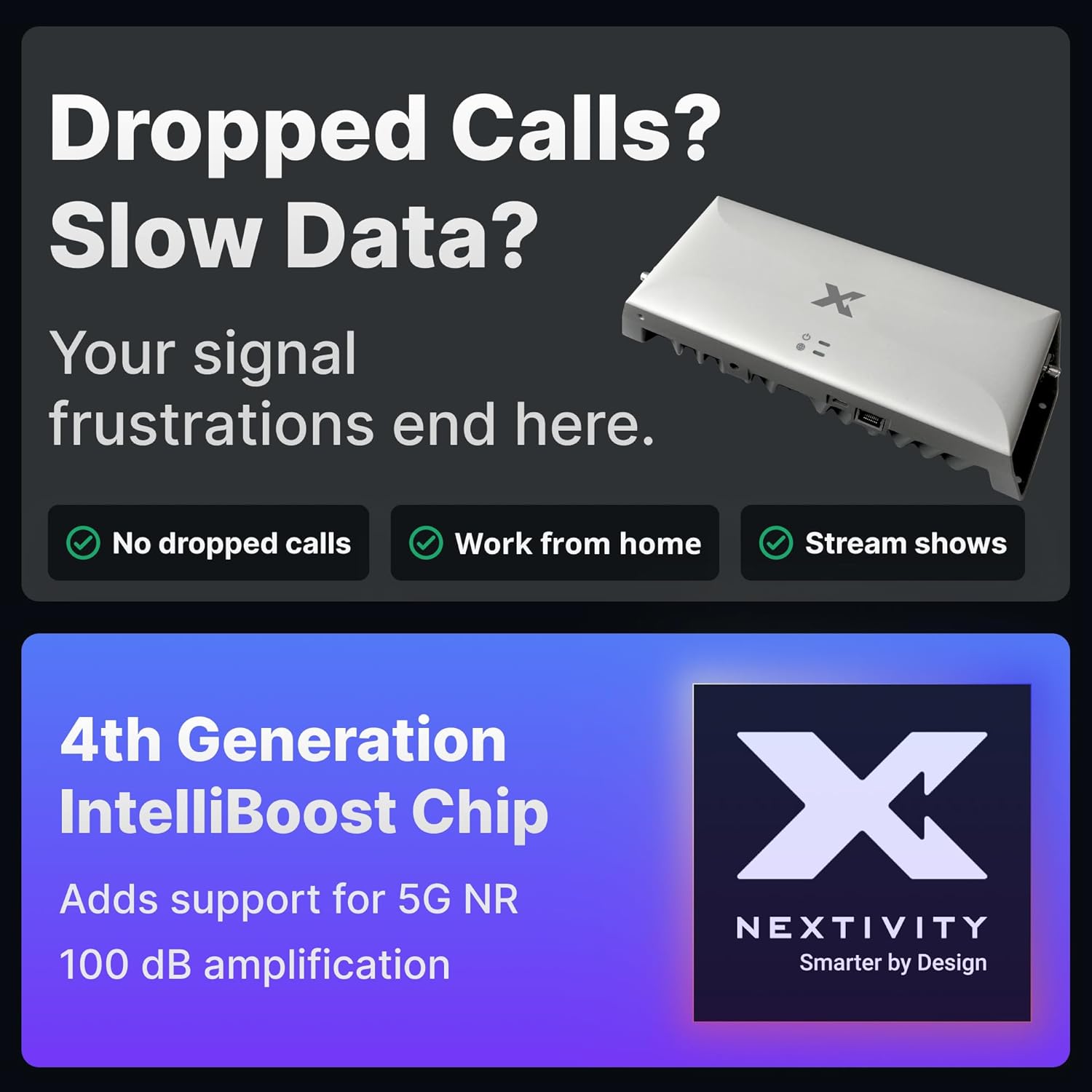
The Cel-Fi GO X is the deliberate outlier in this comparison. Nextivity’s smart-repeater architecture is carrier-specific: you purchase one unit tuned for your carrier (AT&T, T-Mobile, Verizon, and US Cellular versions are available), and it uses Nextivity’s proprietary interference-rejection algorithm to deliver up to 100 dB of gain — roughly 40 dB more than the FCC’s standard Part 20 ceiling for traditional BDAs.
The GO X can legally achieve that gain because it is classified as a network extender rather than a passive amplifier, and it registers with the carrier network automatically upon activation. The FCC’s consumer guidance document “Consumer Signal Boosters,” published on fcc.gov, confirms that smart repeaters operate under a different regulatory classification than standard BDAs — which is precisely why the carrier-locking requirement exists as a condition of that classification.
In practice, what owners consistently report is this: in genuinely low-signal environments — rural properties, buildings with thick masonry walls, locations where the nearest tower is 15 or more miles out — the GO X pulls signal that a traditional BDA running at 72 dB cannot. Starting from –115 dBm or weaker outdoors, the 28 dB gain advantage is real and meaningful. CNET’s “Best Cell Signal Boosters” guide acknowledges the Cel-Fi line’s reputation specifically in rural and fringe-coverage scenarios as the strongest performer in its category.
The significant tradeoffs: You receive 100 dB of gain for exactly one carrier. If your household has mixed carriers — AT&T on your phone, Verizon on a family member’s — one of those phones receives nothing from the GO X. This eliminates the Cel-Fi entirely for mixed-carrier households, rental properties, and any multi-tenant use case. The second tradeoff is coverage area: the GO X’s indoor antenna is designed for a single room or modest open floor plan. For whole-home coverage exceeding 2,000 square feet, the Cel-Fi QUATRA system is the appropriate product — a different and significantly more expensive device that falls outside this comparison.
Who it’s for: Single-carrier households in genuinely weak-signal environments, rural homes where traditional BDAs have already been tried and fallen short, and technically confident owners willing to manage carrier-specific limitations in exchange for maximum gain.
CEL-FI
$1,699.99
In stock on Amazon
Check price on AmazonThe Decision Framework: If X, Then Y
Most buying guides wave vaguely at “it depends.” Here is the actual decision logic, rendered as a branching framework:
Mixed carriers in the household → weBoost Home Complete or Hiboost 10K Smart Link. The Cel-Fi GO X is eliminated immediately. The question becomes budget and DIY confidence. If you want professional installation and a name with deep retailer and support infrastructure, the weBoost premium is justified. If you are comfortable on a ladder and want app-based diagnostics to optimize placement over time, the Hiboost 10K saves $150–$300 on the hardware and matches the weBoost on its single most important specification.
Single carrier, genuinely weak outdoor signal (–105 dBm or worse) → Cel-Fi GO X. The 100 dB gain ceiling is the correct answer here. No traditional BDA at 72 dB will extract as much from a marginal signal. This is the right recommendation for rural single-family homes on one dominant carrier where weaker solutions have already been tried and failed.
Large home (3,000-plus square feet, multi-story) on a single carrier → Cel-Fi QUATRA, not the GO X. The GO X will not cover it adequately. You have outgrown this comparison and should be specifying the QUATRA system or a commercial-grade Wilson Pro installation.
Rental property, vacation rental, or multi-tenant use → weBoost Home Complete or Hiboost 10K, definitively. Guest devices arrive on every carrier. A carrier-locked device serves some guests and ignores others. This is not a close call.
Budget is the hard constraint and outdoor signal is at least –95 dBm → Hiboost 10K Smart Link. At that signal level, you are not leaving meaningful performance on the table relative to the weBoost. The gain ceiling is identical; execution quality is the primary variable, and a careful DIY install with a directional Yagi is achievable in a single afternoon.
The One Thing No Spec Sheet Tells You
The single most common reason a $500 booster underperforms is not the amplifier — it is outdoor antenna placement and aim. The FCC’s consumer guidance document “Consumer Signal Boosters” on fcc.gov specifies that the required minimum separation distance between outdoor and indoor antennas — typically 20 to 50 feet depending on gain level — is a critical installation requirement. When that separation is violated, the amplifier’s automatic gain control compensates for oscillation feedback by throttling itself down. A unit operating at 72 dB capacity but running at 55 dB because of a separation problem will lose to a correctly installed 72 dB unit every time.
This is the actual argument for paying the weBoost Installed Home Complete’s professional installation fee: you are not paying for fancier hardware, you are paying to avoid the single mistake that undermines a significant share of DIY installs. PCMag’s “The Best Cell Phone Signal Boosters” roundup specifically calls out installation quality as a dominant variable in real-world booster performance — more influential than amplifier brand at equivalent gain levels.
If you go the DIY route with either the weBoost hardware kit or the Hiboost 10K Smart Link, invest twenty minutes before purchasing in a call with a pre-sale engineer at an authorized reseller. The better resellers will ask for your address, run a signal propagation estimate, and tell you honestly whether you are a poor candidate for a booster at all. That conversation is worth more than any spec sheet — including this one.