April 29, 2026 • Declan Harte • 10 min reading time • Specs verified June 5, 2026
Overlanding and Off-Road Signal Boosters: weBoost Drive Reach vs. the Field
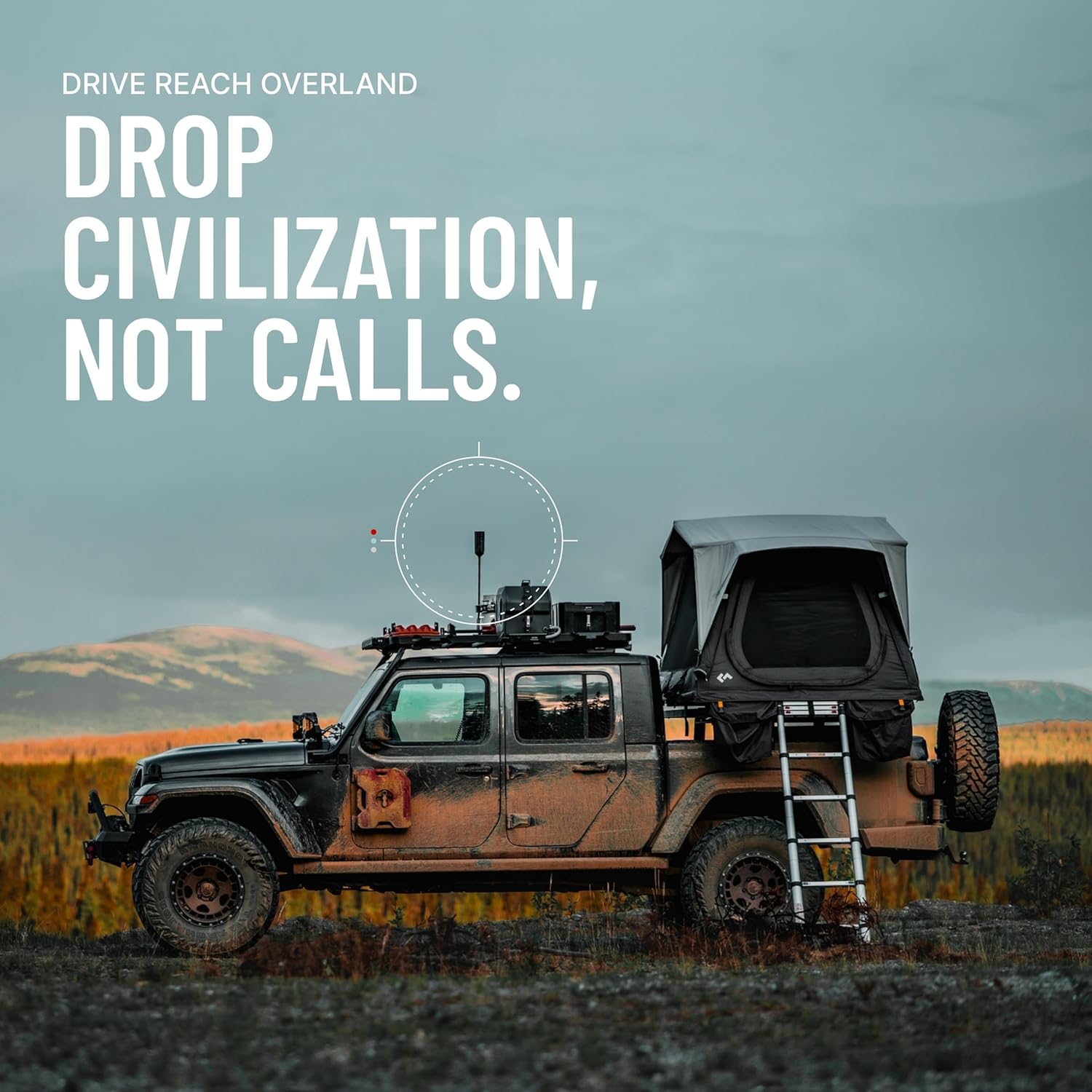
You’re driving a forest road four hours from the last cell tower you’d call reliable. Your navigation app freezes. Your co-pilot can’t get a text out. A signal booster — a small electronic device that grabs whatever faint cellular signal exists in the air, amplifies it, and rebroadcasts it inside your vehicle — is the fix most overlanders reach for before they’d ever pay for a satellite communicator subscription. The device has two antennas: one mounted outside the vehicle to face the tower, one inside the cab to serve your phone. It doesn’t create signal from nothing; it stretches what’s already there. This guide compares the leading options head-to-head so you can make a confident call before your rig leaves the pavement.
| EDITOR'S PICK[weBoost Drive Reach](https://www.amazon.com/dp/B07PDVTMM6?tag=greenflower20-20) Overland -… | Mid-tierLong Range Cellular Antenna - u… | Budget pickweBoost Overland Antenna for Dr… | |
|---|---|---|---|
| FCC approved | ✓ | — | ✓ |
| Carriers | All U.S. | All | All U.S. |
| Range | — | 20 mi | — |
| Gain | — | +26 dB | — |
| Made in USA | ✓ | — | ✓ |
| Price | $549.99 | $199.99 | $119.99 |
| See on Amazon → | See on Amazon → | See on Amazon → |
Why the weBoost Drive Reach Is the Default Starting Point
The weBoost Drive Reach has occupied the top slot in most independent comparisons for the past several years. PCMag’s signal booster coverage (PCMag, “The Best Cell Phone Signal Boosters,” 2025) consistently lists it as the top pick for vehicle use, and Digital Trends’ best car signal boosters roundup (Digital Trends, “Best Car Signal Boosters,” 2025) echoes that ranking. CNET’s ongoing booster coverage (CNET, “Best Cell Phone Signal Boosters,” 2025) similarly calls out the Drive Reach as the benchmark for single-vehicle installs in weak-signal environments.
Here’s why uplink gain matters more than most buyers realize. Your phone is a low-power radio. When you’re 20 miles from a tower on a ridge, the tower can often hear you just fine — the problem is your phone can’t hear the tower’s response. That’s a downlink problem. But the more insidious issue in true backcountry: your phone screaming at the tower and the tower barely catching the signal. That’s an uplink problem. The Drive Reach is spec’d to address both ends of that equation with up to +50 dBm EIRP (Effective Isotropic Radiated Power — the FCC-regulated ceiling for how loud the booster can shout at the tower) on uplink, which is the maximum permitted under FCC Part 20 rules (Federal Communications Commission, “Consumer Signal Boosters,” fcc.gov).
By the Numbers — weBoost Drive Reach vs. Primary Competitors (published specs, 2025–2026):
| Booster | Max Uplink EIRP | Downlink Gain | Band Coverage | Street Price |
|---|---|---|---|---|
| weBoost Drive Reach | +50 dBm | Up to 50 dB | 2G–4G LTE, low-band 5G (n71) | ~$499 |
| SureCall Fusion2Go 3.0 | +50 dBm | Up to 50 dB | 2G–4G LTE | ~$399 |
| weBoost Drive Reach OTR | +50 dBm | Up to 50 dB | 2G–4G LTE, low-band 5G | ~$549 |
| Cel-Fi GO X (vehicle config) | +100 dBm EIRP* | Up to 100 dB gain | 4G LTE (carrier-specific) | ~$700 |
*The Cel-Fi GO X operates under a different regulatory pathway — network-protected, carrier-registered — that allows substantially higher gain. See the tradeoffs section below.
Both the Drive Reach and the Fusion2Go 3.0 sit at the FCC Part 20 ceiling for consumer boosters, meaning on raw gain figures, neither has a legal route to outperform the other. The differentiators are antenna design, band coverage breadth, and how well the kit handles the specific noise environment of an off-road vehicle.
The Field: Who Challenges the Drive Reach and When They Win
SureCall Fusion2Go 3.0 — The Budget-Friendly Value Play
The Fusion2Go 3.0 matches the Drive Reach on every gain figure the FCC allows but comes in roughly $100 cheaper at most retailers. If your driving stays within the contiguous U.S. and you’re primarily working AT&T and Verizon LTE bands — Band 12, Band 13, Band 17 — reviewers and owners consistently report solid results with SureCall’s hardware at that price point.
Where the Fusion2Go gives ground: it lacks the low-band 5G coverage, specifically T-Mobile’s n71 at 600 MHz, that the Drive Reach includes. If your primary carrier is T-Mobile and your overland routes track through the rural West — where n71 is often the only signal present — the Drive Reach’s band table earns its price premium. Outside Online’s 2024 backcountry connectivity coverage (Outside Online, “Stay Connected in the Backcountry,” 2024) noted that T-Mobile’s rural low-band 5G buildout has made n71 coverage a key variable in carrier selection for remote travel, which means it’s also a key variable for booster compatibility.
The practical decision frame: If your carrier is AT&T or Verizon and you’re price-sensitive, the Fusion2Go 3.0 is a genuine competitor at around $399. If you’re on T-Mobile or want carrier-agnostic coverage for a rig that multiple people with different carriers will use, spend the extra $100 for the Drive Reach.
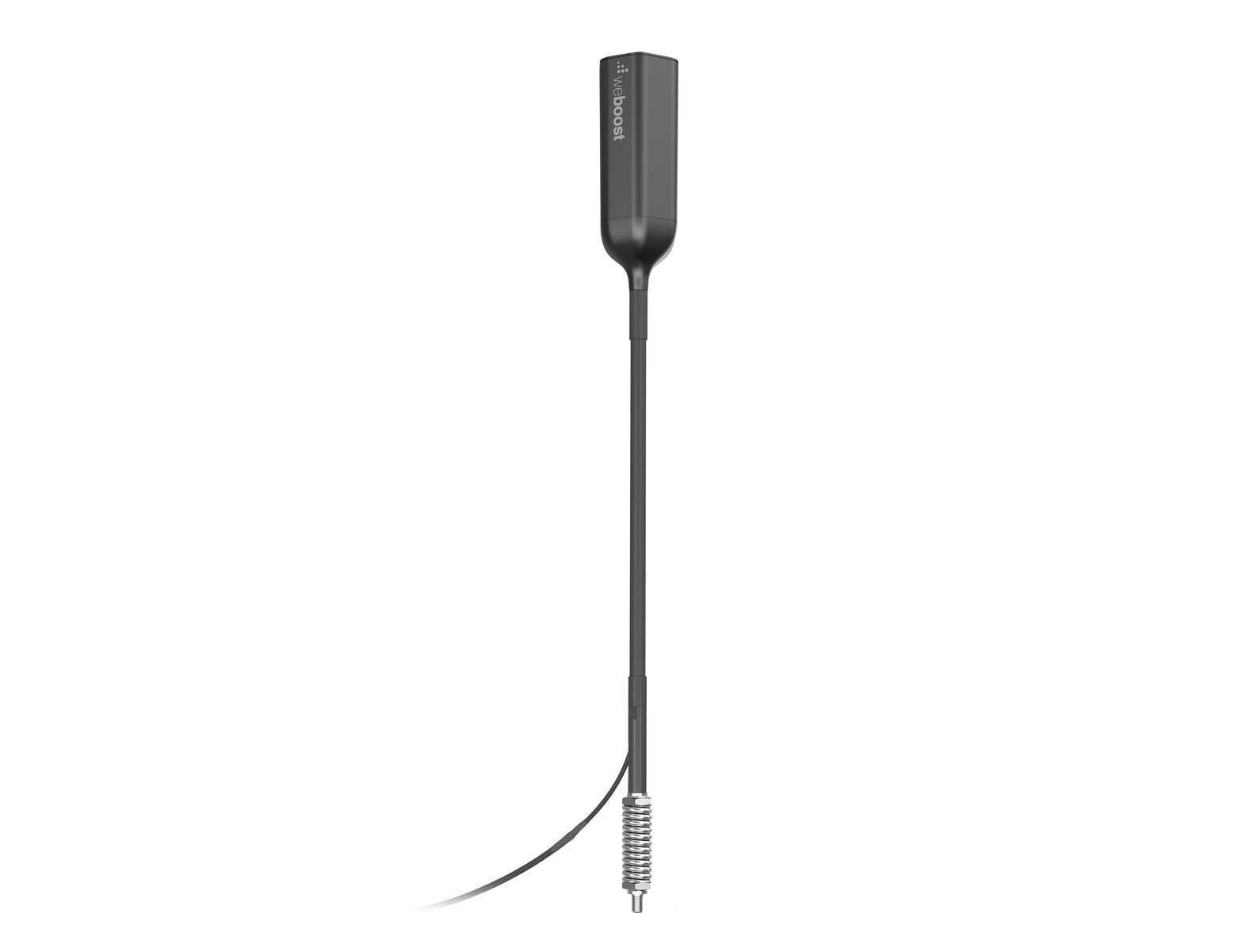
weBoost
$119.99
In stock on Amazon
Check price on AmazonweBoost Drive Reach OTR — For Trucks and Serious Roof Racks
The OTR variant swaps the standard magnetic-mount outside antenna for a heavy-duty permanent-mount antenna designed to handle vibration, brush contact, and the aerodynamic punishment of highway speeds with a loaded roof rack. The gain figures are identical to the standard Drive Reach — this is an antenna ruggedness and mounting upgrade, not a signal-ceiling upgrade.
At roughly $549, you’re paying approximately $50 over the standard Drive Reach for the antenna swap. If your rig has a roof rack, runs recovery boards on the roof, or you simply don’t want a magnet mount that can walk at speed, that’s a worthwhile premium. If you’re running a daily-driver SUV that occasionally goes off-road, the standard Drive Reach is the better value. PCMag’s vehicle booster coverage (PCMag, “The Best Cell Phone Signal Boosters,” 2025) specifically calls out the OTR’s mounting system as the reason to step up from the standard model rather than any underlying electronic difference.
The practical decision frame: Choose the OTR if your vehicle has a permanent rack system or if you run two-tracks where branches and brush make a permanent mount genuinely safer than a magnetic one. Otherwise, save the $50.
Long
$199.99
In stock on Amazon
Check price on AmazonCel-Fi GO X — The Carrier-Specific Premium Option
The Cel-Fi GO X operates in a fundamentally different category from the FCC Part 20 consumer boosters above. While consumer boosters are capped at +50 dBm uplink EIRP, the GO X is a network-protected device that requires carrier registration and uses sophisticated interference-avoidance technology. That regulatory pathway permits up to +100 dBm EIRP — and on a logarithmic scale, every 10 dB represents roughly a tenfold increase in effective power. In practice, at the absolute margins of coverage — a single bar or less on a ridge — the GO X can maintain connections that the Drive Reach cannot.
The tradeoffs are real and worth naming explicitly:
- Carrier lock. The GO X is configured for specific carriers. A unit registered for T-Mobile will not boost AT&T. In a multi-carrier vehicle — an overlanding group, a fleet truck — this is a genuine constraint.
- Price. At around $700, you’re paying roughly 40 percent more than the Drive Reach for a use case many overlanders will never actually hit.
- Registration friction. Carrier registration adds a step that some operators find cumbersome, and activation can be glitchy depending on the carrier’s provisioning system.
Digital Trends’ car signal booster coverage (Digital Trends, “Best Car Signal Boosters,” 2025) notes the GO X as the correct recommendation specifically for single-carrier power users who regularly push into fringe coverage, while explicitly steering mixed-use buyers toward the Drive Reach tier.
The practical decision frame: If you operate a single-carrier fleet — work trucks all on Verizon, or a solo overlander exclusively on T-Mobile — and you regularly run single-bar territory, the GO X’s gain advantage is real and worth the premium. For mixed-use recreational rigs, the Drive Reach is the right balance of gain, flexibility, and price.
weBoost
$549.99
In stock on Amazon
Check price on AmazonAntenna Placement and the Mistakes That Negate the Hardware
Buying the right booster is half the job. The FCC’s Part 20 framework and Wilson Electronics’ published installation documentation both emphasize a point that aggregated owner experience validates consistently: oscillation is the most common failure mode, and it’s almost always caused by the outside and inside antennas being too close together or aimed toward each other.
Oscillation is the booster equivalent of a microphone too close to a speaker — the inside antenna picks up the amplified signal and re-feeds it to the outside antenna, creating a feedback loop that trips the booster’s auto-shutoff protection. The unit drops into a reduced-gain safety mode or shuts off entirely, and the owner concludes the booster doesn’t work.
For vehicle installs, the general rule is 12–18 inches of vertical or horizontal separation between the outside (roof) antenna and the inside (cab) antenna. In a compact SUV or pickup cab, this clearance is tight. Owners in long-run use consistently note that routing the inside antenna cable to the rear cargo area — away from the driver cluster — reduces oscillation in shorter vehicles.
The second common mistake: pointing the outside antenna straight up instead of toward the horizon. Cell towers are ground-based. An omni antenna oriented skyward loses signal it should be capturing laterally. Wilson’s published installation guidance recommends a slight forward or rearward tilt on directional outside antennas when the tower direction is known. For overlanding where tower direction changes constantly, an omni outside antenna — which both the Drive Reach and Fusion2Go 3.0 ship with — is correct. Just verify the element is mounted vertically, not canted sideways by a sloppy bracket.
5G Claims: What’s Real, What’s Marketing
Per the FCC’s current Part 20 framework (Federal Communications Commission, “Consumer Signal Boosters,” fcc.gov), consumer signal boosters can legally amplify low-band 5G frequencies: specifically, T-Mobile’s n71 (600 MHz) and n5 (850 MHz), and limited band-specific coverage on AT&T and Verizon’s low-band 5G deployments. The weBoost Drive Reach covers n71 and markets itself as “5G compatible” on that basis — and that claim is technically accurate.
What no consumer booster can amplify: mid-band 5G (n41, n77, n78 — the 2.5 GHz and C-band frequencies that deliver the fast speeds in T-Mobile and Verizon’s urban 5G advertising) and certainly not mmWave. These bands are physically incompatible with current Part 20 booster architecture. Any booster marketed as “boosting 5G” that doesn’t specify n71 or n5 in its band table is using marketing language loosely, at best.
For overlanding specifically, this distinction mostly doesn’t matter in practice — mid-band 5G does not exist on remote forest roads. Low-band 5G does. The Drive Reach’s n71 support is a real differentiator on T-Mobile networks in rural areas, not a spec-sheet fiction.
If X, Then Y: The Decision Rules
If you’re on T-Mobile and regularly drive remote rural routes in the West or Midwest: weBoost Drive Reach (~$499). The n71 band support is the deciding factor; nothing at this price matches it for T-Mobile rural depth.
If you’re on AT&T or Verizon and watching the budget: SureCall Fusion2Go 3.0 (~$399). Identical gain ceiling, genuine savings, and the band gap won’t affect your carrier’s network in practice.
If your rig is a built truck or carries a permanent roof rack: weBoost Drive Reach OTR (~$549). The heavier-duty antenna mount earns its modest premium the first time you run a brushy two-track at speed.
If you’re a single-carrier fleet operator or a solo overlander who regularly pushes into single-bar coverage: Cel-Fi GO X (~$700). The gain advantage is real at the margins. Accept the carrier lock, complete the registration, and you’ll have the most powerful legal consumer option available.
If you need help sizing an antenna cable run or diagnosing a specific dead-zone problem before you buy: specialty retailers focused on signal booster hardware typically offer free pre-sale engineering consultation — worth more than any discount on a $500 kit you might return.
Whatever you buy, verify FCC Part 20 certification before purchase. The FCC’s published database of certified boosters, searchable by FCC ID at fcc.gov, is the authoritative check — not the product listing copy, not the retail box.