May 29, 2026 • Declan Harte • 9 min reading time • Specs verified June 5, 2026
Match Your Dead Zone to the Right Home Booster: A Square-Footage Buying Guide
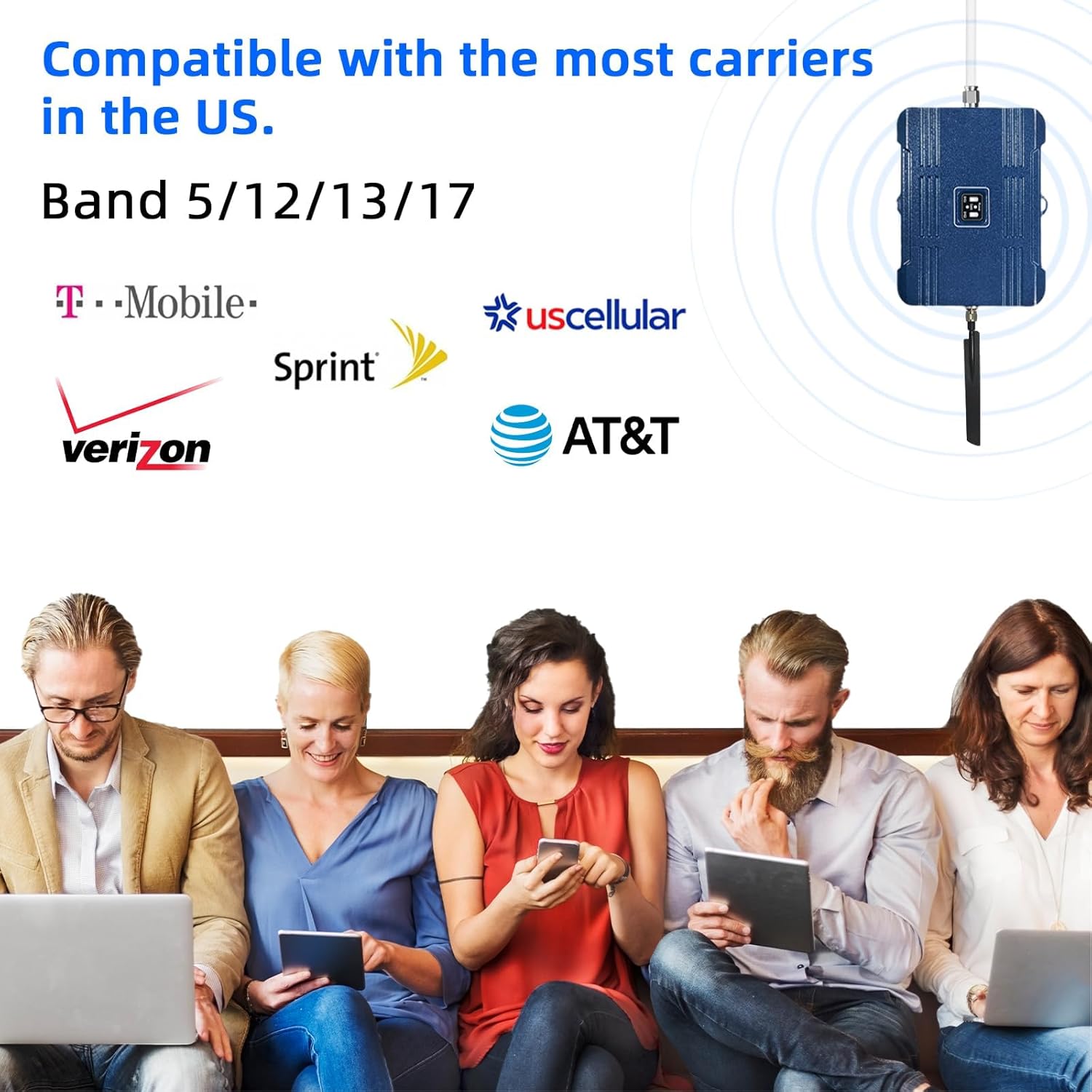
If you’ve ever walked into your kitchen and watched your phone drop from four bars to one — or worse, watched a video call freeze mid-sentence because your back bedroom is a dead zone — you already know the problem. A cell signal booster is a device that catches the weak signal coming in from the nearest carrier tower, amplifies it, and rebroadcasts it inside your home. Think of it as a translation amplifier: the outdoor antenna listens hard for a faint signal, the amplifier unit turns up the volume, and the indoor antenna spreads the improved signal through your living space. The catch is that “the right booster” depends entirely on how much space you need to cover, how weak your outside signal is to start with, and how your home is built. Buy too small and you’ll cover one room. Buy without understanding your outside signal and you may return it frustrated, just like the person who wrote that one-star Amazon review you scrolled past.
This guide cuts through the size confusion. We’ll map square footage to specific products, show you where the real performance cliffs are, and give you a clear decision rule at the end.
| EDITOR'S PICKHiboost Cell Phone Signal Boost… | Mid-tierHiboost Cell Phone Signal Boost… | Budget pickCell Phone Booster for Home Off… | |
|---|---|---|---|
| Coverage Area | 8000 sq ft | 4000 sq ft | 2500 sq ft |
| Indoor Antennas | 2 | — | — |
| FCC Approved | — | ✓ | ✓ |
| Carrier Support | All US Carriers | All US Carriers | All U.S. Carriers |
| Color | — | Black | Dark Blue |
| Price | $599.99 | $399.99 | $84.99 |
| See on Amazon → | See on Amazon → | See on Amazon → |
Why Square Footage Is Only Half the Equation
Manufacturers list coverage figures like “up to 5,000 sq ft” on the box, and those numbers are technically honest — under ideal conditions. The real variable is your outdoor signal strength, measured in dBm (decibels relative to a milliwatt). You don’t need to memorize that phrase. Just know this: a booster amplifying a strong outside signal will cover close to its rated area. A booster fighting a weak outside signal — the scenario that applies to most people buying one — will cover significantly less.
PCMag’s roundup of the best signal boosters (updated 2026) consistently flags this: a unit rated for 5,000 sq ft might realistically cover 1,500–2,000 sq ft when the outside signal is genuinely poor (think: rural fringe, or a building surrounded by hills). CNET’s signal booster coverage echoes the same caveat. The FCC’s consumer guide on signal boosters reinforces that amplifier gain — how much the unit boosts the signal — is regulated under FCC Part 20, so no manufacturer can legally sell you infinite power. The ceiling matters.
The practical takeaway: Before you size by square footage, stand outside your home with your phone’s field test mode open and note the dBm reading. Values between -50 and -80 dBm are strong. Between -80 and -100 dBm is workable but marginal. Below -100 dBm (closer to -110 or -120) means you need maximum gain and the most aggressive antenna setup you can manage.
By the Numbers: Coverage Reality Check
| Outside Signal (dBm) | Rated Coverage (example: 5,000 sq ft unit) | Realistic Indoor Coverage |
|---|---|---|
| −65 to −75 dBm (strong) | ~5,000 sq ft | ~4,500–5,000 sq ft |
| −80 to −95 dBm (moderate) | ~5,000 sq ft | ~2,000–3,000 sq ft |
| −100 to −110 dBm (weak) | ~5,000 sq ft | ~500–1,500 sq ft |
| Below −110 dBm (very weak) | ~5,000 sq ft | Single room or less |
The Booster Tiers, Matched to Real Homes
Under 1,500 Square Feet (Apartments, Condos, Small Homes)
If you’re in an apartment or a smaller single-family home and you have one or two problem rooms — not a whole-building dead zone — a mid-tier single-user or small-room booster is the right starting point. The weBoost Home Room (manufacturer-rated at up to 1,500 sq ft, street price around $200–$250) fits this use case cleanly. It runs a single indoor panel antenna, which means you point coverage at a specific area rather than broadcasting omnidirectionally.
For apartment dwellers, the complication is antenna placement. Most buildings prohibit exterior antenna mounting, which means you’re relying on a window-mount outdoor antenna. Window glass attenuates the signal before it even reaches the booster, so owners in high-rise buildings frequently report that the effective coverage shrinks further than spec. If your apartment is above the 10th floor with a clear line of sight to a tower, you’ll do better than someone on the second floor surrounded by concrete structures.
Decision rule for this tier: If your outside signal reads above −85 dBm and you need coverage in 1–2 rooms, a Home Room-class unit will do the job. If you’re already at −95 dBm or worse, step up — or invest in antenna placement work first.
1,500 to 5,000 Square Feet (Typical Suburban Homes, Townhouses)
This is the most crowded tier — and the one with the most products competing for your wallet. The benchmark product here is the weBoost Home MultiRoom (manufacturer-rated at up to 5,000 sq ft, street price ~$350). It supports multiple simultaneous users, ships with an omnidirectional indoor antenna for broad coverage, and works across all U.S. carriers on 4G LTE and low-band 5G (bands like n71 and n5). That last point matters: reviewers at PCMag note that legitimate 5G booster claims apply only to low-band 5G because mid-band (n41) and mmWave cannot be amplified under current FCC Part 20 rules. Any product marketing that implies otherwise deserves scrutiny.
The SureCall Fusion4Home (spec sheets put it at comparable gain figures to the MultiRoom, street price in the same $300–$380 range) is the other credible competitor in this tier. Owners in aggregated reviews tend to describe both units similarly for moderate suburban use, though SureCall’s lineup has historically offered slightly more configuration flexibility for installers who want to run in-wall cable rather than the included flat window cable.
For homes where the dead zone is structural — thick CMU block construction, metal roofing, or a basement office — a single indoor omnidirectional antenna won’t cut it. You’ll need to run coax to a second indoor antenna panel aimed at the problem area. Both the MultiRoom and Fusion4Home support this with an optional second antenna on a splitter, though you’ll lose a few dB of gain at the split. Waveform.com’s pre-sale support team (they do free install consultations) is particularly good at walking buyers through this calculation before purchase.
Decision rule for this tier: A standard two-story, wood-frame home with a moderate outside signal (−80 to −90 dBm) and 2,000–4,000 sq ft is the MultiRoom’s sweet spot. If you have a basement plus two stories, or construction that eats signal, budget for a second indoor antenna or move to the next tier.
5,000 to 7,500 Square Feet and Beyond (Large Homes, Rural Properties)
At this size, you’re either spending more on the amplifier, spending more on antenna infrastructure, or both. The weBoost Installed Home Complete (~$1,000 installed, varies by market) is the benchmark we treat as the logical end-state for serious residential buyers, and for good reason: the installation includes a professional site survey, optimized outdoor antenna aim, and proper cable routing — the three variables that cause 90% of DIY booster failures at this square footage. Manufacturer ratings put it at up to 7,500 sq ft, but owners in rural installs consistently report that the professional antenna placement is what actually unlocks that coverage, not the hardware alone.
For the DIY-committed buyer at this tier, the Nextivity Cel-Fi GO X (street price ~$700) takes a different technical approach. Rather than a traditional bi-directional amplifier with an AGC (automatic gain control), the Cel-Fi GO X uses Nextivity’s “Smart Signal” architecture, which allows up to 100 dB of gain — significantly more than the FCC’s standard 70 dB limit for consumer boosters — because Nextivity operates under a carrier-approved “network extender” framework rather than the standard Part 20 consumer booster rules. Nextivity’s own product documentation explains this distinction carefully. The tradeoff: the GO X is single-carrier (you register it to one carrier at setup) and requires a stronger minimum outside signal to operate than a traditional amplifier. It is not the right tool for a truly fringe rural signal.
For rural properties where signal is genuinely weak and coverage needs to reach outbuildings, a yagi directional outdoor antenna paired with a high-gain amplifier is the standard professional recommendation. Powerful Signal’s consulting staff (another specialty retailer worth a call before buying) frequently steers rural buyers toward directional outdoor antenna setups regardless of which amplifier they choose.
Decision rule for this tier: If you’re within range of a carrier’s strong signal but just blocked by walls or square footage, the GO X or a professionally installed weBoost system wins. If you’re genuinely rural and fighting a weak signal at the source, prioritize antenna gain and outdoor antenna placement over amplifier brand.
The Mistakes That Eat Coverage — Regardless of Budget
Before closing, the two installation errors worth naming explicitly because they account for most booster disappointments at every tier:
Separation distance. Every booster system requires physical separation between the outdoor antenna (receiving the tower signal) and the indoor antenna (rebroadcasting it). If the two antennas can “hear” each other, the system oscillates and shuts down automatically. Most boosters need 15–25 feet of vertical separation minimum. Manufacturers publish these figures in their installation guides; the FCC’s signal booster consumer documentation also addresses this as a required design constraint. In a single-story home, this is genuinely hard to achieve — and it’s the primary reason single-story ranch homes underperform expectations.
Outdoor antenna aim. An omnidirectional outdoor antenna is forgiving but sacrifices gain. A yagi (directional) antenna aimed precisely at the nearest tower adds meaningful dB — but “precisely aimed” means within a few degrees, not “roughly pointed that way.” Owners who skip the compass-and-tower-locator step and just mount the antenna at a convenient angle consistently report underperformance. Tools like CellMapper (the crowd-sourced tower database, not an affiliated site) or your carrier’s network tool help you identify the right bearing before you drill anything.
If X, Then Y: Your Buying Decision in Plain Language
- Apartment or condo, 1–2 dead rooms, outside signal above −85 dBm → weBoost Home Room (~$200–$250). Don’t overspend; the coverage area you need is small and the hardware ceiling is enough.
- Typical suburban home, 2,000–4,000 sq ft, standard construction, moderate signal → weBoost Home MultiRoom (
$350) or SureCall Fusion4Home ($350). Either is a solid pick; call Waveform for a second-antenna plan if you have a basement. - Large home, 5,000+ sq ft, or rural property with strong enough outside signal → Nextivity Cel-Fi GO X (
$700) for single-carrier simplicity, or budget for the weBoost Installed Home Complete ($1,000) if you want the professional antenna placement that actually unlocks the spec. - Rural fringe, signal below −100 dBm, multiple buildings to cover → Start with a directional yagi outdoor antenna setup and get a pre-sale consult from Waveform or Powerful Signal before buying anything. The antenna decision matters more than the amplifier brand at this signal level.
The booster market rewards buyers who size correctly and install carefully. Get those two things right and the hardware almost always delivers. Get them wrong and even a $700 unit feels like money wasted.