April 23, 2026 • Declan Harte • 11 min reading time • Specs verified June 5, 2026
5G Booster Marketing vs. Reality: What Those '5G Ready' Labels Actually Mean

You’ve probably seen the packaging: a glossy box stamped with “5G Ready!” in bold, alongside a lightning bolt graphic and some reassuring language about next-generation speed. If you’re shopping for a signal booster — a device that captures weak cellular signal outdoors, amplifies it, and rebroadcasts it inside your home, office, or vehicle — that label might be the first thing that catches your eye. The problem is that “5G ready” can mean almost anything, or almost nothing, depending on which slice of 5G the manufacturer is talking about. And since most buyers don’t yet have a working map of how 5G is actually structured, that ambiguity is doing a lot of marketing work. This article is a guided tour through that gap: what the label technically promises, what physics and FCC rules actually permit, and how to match a booster’s real capability to the signal your carrier is actually broadcasting where you live.
| EDITOR'S PICK[CEL-FI GO G41 Cell Phone Booste…](https://www.amazon.com/dp/B0CNTZQ1DB?tag=greenflower20-20) | Mid-tier[weBoost Home Complete | Powerfu…](https://www.amazon.com/dp/B07RQVVVQG?tag=greenflower20-20) | Budget pickCell Phone Booster for Home Off… | |
|---|---|---|---|
| Coverage Area | 15,000 sq ft | — | 2,500 sq ft |
| Max Gain | 100 dB | — | — |
| FCC Approved | ✓ | — | ✓ |
| Antenna Included | 2X Antenna with Grid | — | — |
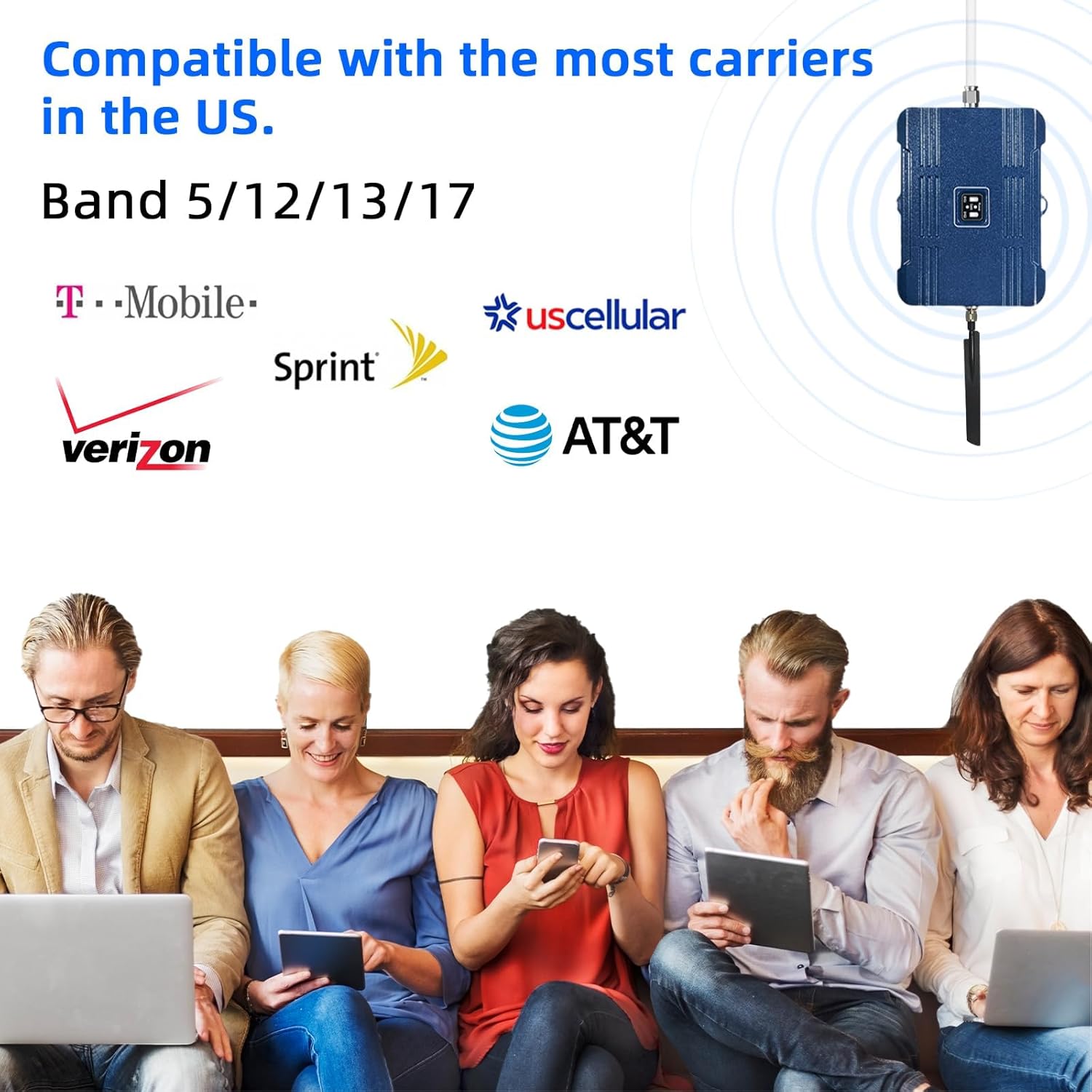
| Band Support | — | — | Band 5/12/13/17 |
| Price | $1,999.99 | $999.99 | $84.99 |
| See on Amazon → | See on Amazon → | See on Amazon → |
The Three Flavors of 5G — And Why Only One Is Boostable
5G isn’t a single technology. It’s a marketing umbrella covering three physically distinct frequency ranges, each with completely different behavior. Understanding the difference is the entire game.
Low-band 5G (Sub-1 GHz) uses frequencies below 1 GHz — most commonly the n71 band (600 MHz, used heavily by T-Mobile) and the n5 band (850 MHz, used by AT&T and Verizon). These signals travel far, penetrate walls reasonably well, and are already widely deployed across rural and suburban America. Critically, they operate in frequency ranges that consumer-grade boosters can legally amplify under FCC Part 20 rules, which cap booster gain and output power to prevent interference with carrier networks. As of mid-2026, virtually every reputable booster manufacturer has updated their hardware to cover n71 and n5.
Mid-band 5G (roughly 2.5 GHz to 6 GHz) is where the real speed gains live — the n41 band (2.5 GHz, T-Mobile’s “Ultra Capacity” 5G), the C-band (n77/n78, around 3.7–3.98 GHz, central to Verizon and AT&T’s mid-band buildout), and adjacent bands. This is the tier that delivers the 300–900 Mbps speeds carriers advertise in dense urban and suburban areas. Current FCC Part 20 rules do not permit consumer signal boosters to operate in these bands. Any box claiming to boost mid-band 5G is either mislabeling what it does or operating outside legal certification — both of which should end the conversation immediately.
mmWave 5G (24 GHz and above) is ultra-high-frequency and cannot practically penetrate a single pane of glass, let alone a wall. It’s a venue-specific and outdoor technology relevant primarily to stadium distributed antenna system installs and fixed-wireless access deployments. Consumer boosters don’t touch it, and no credible manufacturer argues they should.
At a glance:
- Low-band 5G (n71, n5, n29): boostable under Part 20 ✓
- Mid-band 5G (n41, n77, n78, C-band): not boostable under current FCC rules ✗
- mmWave 5G (n257, n260, n261): physically impractical to boost ✗
What ‘5G Ready’ Actually Certifies — And What It Doesn’t
When a booster carries a “5G ready” label and an FCC Part 20 certification number — which should be printed on the device and verifiable through the FCC’s equipment authorization database at fcc.gov — what it legally guarantees is narrow but real. The device has been tested and approved to amplify the specific frequency bands listed in its spec sheet, and those bands include at least one 5G-designated frequency in the low-band range.
Per the FCC’s published consumer guidance on wireless signal boosters, all consumer boosters sold in the U.S. must carry Part 20 certification. That certification is band-specific. A booster certified for Band 12/17 (700 MHz) and Band 71 (600 MHz) will amplify low-band 5G signals on n71 — because n71 and Band 71 LTE are the same physical frequency. The “5G” label reflects that the signal protocol riding those frequencies has been upgraded by carriers, not that the booster contains any special 5G hardware inside.
This is the core of the marketing sleight-of-hand: the booster doesn’t know or care whether the signal it’s amplifying is 4G LTE or 5G NR (New Radio). It amplifies RF energy within a frequency range. If your carrier happens to be broadcasting 5G protocol on a frequency the booster supports, the booster will pass it through. If your carrier is broadcasting 5G on a mid-band frequency the booster doesn’t support — and legally can’t — no improvement will occur, regardless of what the box says.
PCMag’s coverage of the best cell phone signal boosters has consistently flagged this distinction, noting that shoppers should verify the specific bands on a device’s spec sheet rather than relying on generational marketing labels. CNET’s signal booster buying guide echoes this, advising buyers to cross-reference their carrier’s band deployment map against a booster’s certified band list before purchase. Both publications treat the band-match exercise as the single most important step in the buying process — not the “5G” label on the front of the box.
How Carrier Deployments Break the Promise in Practice
For practitioners making a spec decision — whether you’re an IT director evaluating office coverage or a homeowner who’s already returned one booster — the band-match exercise is non-negotiable. Here’s how it works in practice.
Identify your carrier’s actual deployed bands in your location. T-Mobile’s network relies heavily on n71 as its workhorse low-band 5G layer across rural and suburban markets, while n41 carries the speed load in urban cores. AT&T and Verizon have been aggressively deploying C-band (n77) since 2023, which means their marquee 5G signal in many suburban markets is mid-band — and unboostable. RCR Wireless News has tracked these deployment patterns in its infrastructure coverage as part of its ongoing reporting on U.S. carrier network buildouts.
Map your building’s signal environment. A booster only helps if there’s an outdoor signal to amplify. If the nearest tower is delivering C-band n77 at -65 dBm and low-band n5 at -105 dBm, the booster will amplify the weak n5 signal — which is boostable — not the strong n77 signal, which isn’t. You may end up with modestly better low-band 5G or LTE indoors, but the mid-band gap remains unsolved.
Match the booster to both outdoor signal strength and coverage need. This is where gain figures matter. A device rated at 65 dB gain handles typical suburban dead zones where outdoor signal is already marginal. When outdoor signal is genuinely weak — -100 dBm or worse — you need a smart amplifier design that maximizes every available decibel, and carrier registration matters for legal operation at those gain levels. For enterprise buildouts, higher output power and multi-antenna architecture handle larger square footages, but the 5G capability of any device in that stack is still bounded by the same Part 20 constraints.
One underappreciated variable: many carriers are increasingly using uplink-heavy configurations on low-band 5G to extend coverage. A booster that’s balanced for uplink gain — your phone transmitting to the tower — versus downlink gain — the tower transmitting to your phone — can meaningfully improve call quality and data stability even when raw download speed improvement is modest.
Comparing Your Options: Budget, Mid-Tier, and Premium
The “5G ready” label appears across every price tier. Here’s how the real-world comparison breaks down once you strip away the marketing.
Budget-Tier Boosters: Low-Band 5G at Entry Price
Entry-level consumer boosters in the $200–$350 range typically cover one or two frequency bands, are designed for a single room or small apartment, and are engineered for outdoor signal that’s weak but not critically so (roughly -85 to -95 dBm at the outdoor antenna). Their “5G ready” claim is legitimate in the narrowest sense: if your carrier’s low-band 5G is present outdoors, you’ll see it indoors. What you won’t see is mid-band speed improvement, and you won’t cover a large floor plan. For T-Mobile customers in suburban markets where n71 is the primary 5G layer, a budget booster delivers genuine value. For AT&T and Verizon customers in areas where C-band is the dominant 5G signal, the same device solves a different, smaller problem than advertised.
Cell
$84.99
In stock on Amazon
Check price on AmazonMid-Tier Boosters: Whole-Home Coverage, Same Band Constraints
Mid-tier devices in the $400–$600 range — the category where the weBoost Home MultiRoom sits, as reviewed in detail by both PCMag and CNET in their signal booster roundups — add broader band coverage, higher gain (typically 65 dB), and antenna configurations suited to homes up to 5,000 square feet. The upgrade over budget devices is real: better penetration of building materials, more simultaneous users supported, and more band diversity that helps in areas where carriers have deployed multiple low-band frequencies. The “5G ready” improvement at this tier is the same as at the budget tier — low-band 5G only — but the improved gain means you’re more likely to actually pull that weak outdoor signal inside reliably.
weBoost
$999.99
In stock on Amazon
Check price on AmazonPremium and Professional-Grade Boosters: When the Job Is Bigger Than a Home
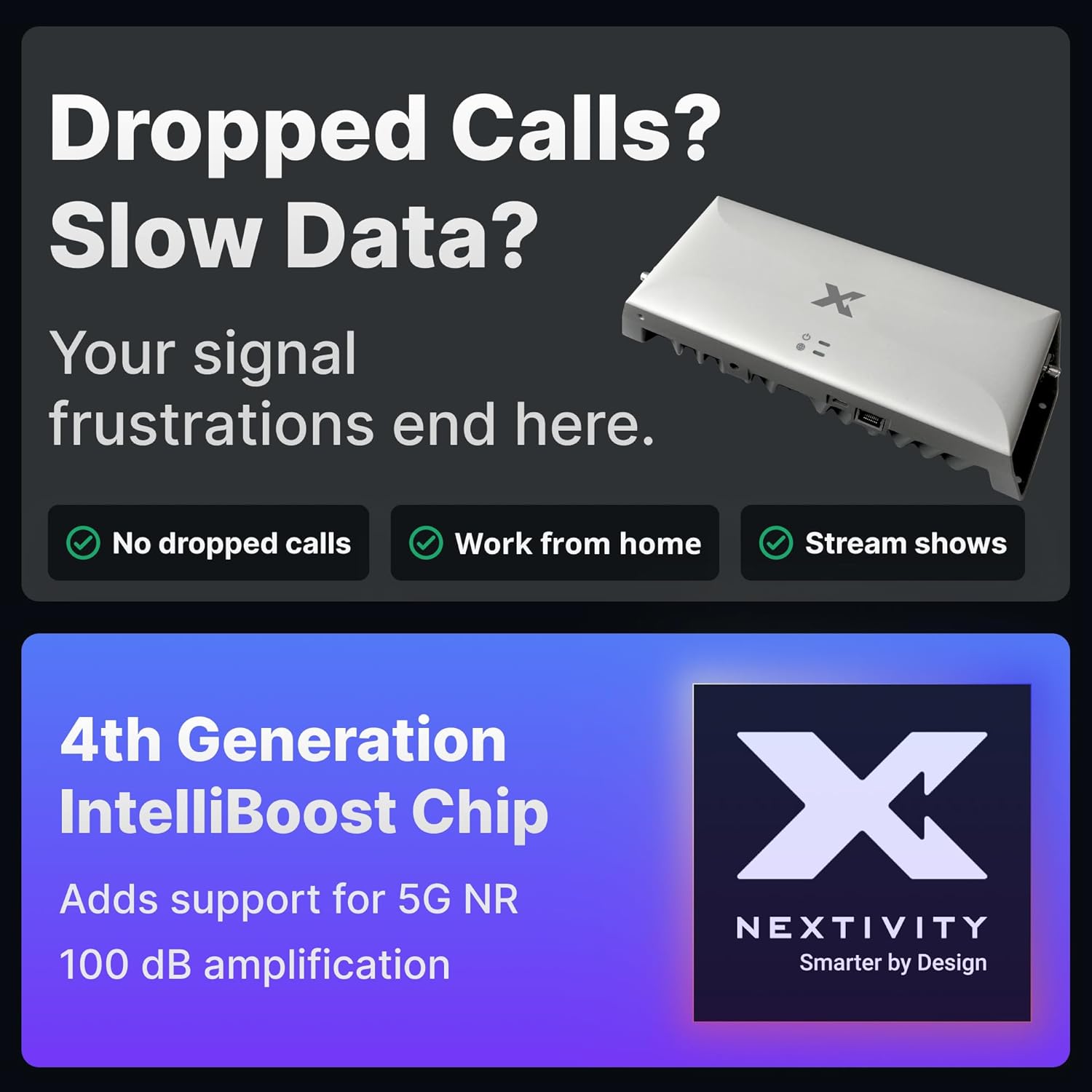
Premium consumer and prosumer devices — the weBoost Installed Home Complete, the Nextivity Cel-Fi GO X, and enterprise platforms like the Wilson Pro 70 Plus — address use cases where the mid-tier solution falls short: rural properties with genuinely weak outdoor signal, commercial buildings with challenging RF environments, or users who’ve already confirmed the outdoor signal is there but can’t get it inside reliably. The Cel-Fi GO X uses a smart amplifier design with higher gain than standard Part 20 devices allow by operating in a carrier-registered mode — it’s paired to one carrier, operates within that carrier’s network awareness, and achieves up to 100 dB of gain as a result. The weBoost Installed Home Complete adds a professional site assessment component, addressing the antenna-placement mistakes responsible for most installation failures. At the enterprise level, the Wilson Pro 70 Plus brings multi-port architecture for distributed indoor antennas across large commercial spaces. None of these devices bypass the mid-band restriction. What they offer is the best possible amplification of the low-band 5G and LTE signals that are legally boostable — and for many buyers, that’s the actual problem they need to solve.
CEL-FI
$1,999.99
In stock on Amazon
Check price on AmazonThe Decision Frame: Which Scenario Are You In?
If your carrier’s primary 5G layer in your area is low-band (T-Mobile n71, or AT&T/Verizon 700/850 MHz upgraded to 5G NR): a certified Part 20 booster covering those bands will deliver real improvement. For a single-family home under 4,000 sq ft with moderate signal loss, a mid-tier device is the sensible call. For rural properties with weak outdoor signal, step up to a high-gain smart amplifier or a professionally installed system.
If your carrier’s primary 5G layer is mid-band (C-band n77, T-Mobile n41 in urban deployments): no consumer booster legally addresses this gap today. Your options are: Wi-Fi calling through your router instead of a booster; a carrier-supplied network extender device that connects over broadband rather than RF; or waiting for FCC rulemaking that may eventually expand Part 20 to cover additional bands — which RCR Wireless News has tracked as an ongoing regulatory discussion but not a near-term outcome as of mid-2026.
If you’re in a vehicle, RV, or marine context: the band math still applies, but the use case shifts. You’re chasing coverage at the cell-edge rather than solving a fixed building-penetration problem. Purpose-built vehicle kits are engineered for lower gain by design — because you don’t need to punch through walls, you need stable handoff as you move between towers. The “5G ready” label on vehicle boosters follows the same logic as home units: low-band 5G benefits; mid-band does not.
If you’re speccing a commercial property: the distributed antenna system conversation is separate from consumer booster math. Enterprise systems operate under different output power ceilings and antenna distribution architectures. Carriers increasingly require network registration or formal neutral-host agreements for commercial deployments. An engineering consultation from a professional installer is worth more than any online comparison chart, because antenna-placement and separation-distance variables in a complex building determine whether the system performs or becomes an interference source.
The Bottom Line on ‘5G’ Labels
The honest version of “5G ready” is this: the device will amplify any RF signal — LTE or 5G — that falls within its certified frequency bands, provided those bands are in the low-band range where Part 20 rules allow amplification. That’s genuinely useful for a meaningful slice of the market, particularly T-Mobile customers in rural and suburban markets where n71 is the 5G workhorse.
The version the packaging lets you believe — that buying a “5G booster” puts you ahead of the mid-band speed curve — is false, and it will remain false until either FCC rules change or mid-band signals become boostable without the interference problems that currently prevent it. The FCC’s consumer guidance on signal boosters, PCMag’s booster reviews, and CNET’s buying guide all point to the same verification step: check the certified band list, cross-reference it against your carrier’s actual deployed frequencies in your location, and make the decision from there.
Pull up your carrier’s network band map. It takes five minutes and is freely available. The FCC’s Part 20 certification database confirms what any given device is legally allowed to do. Everything else — gain figures, antenna placement, coverage area estimates — has clear, learnable answers once you know which frequency problem you’re actually trying to solve.